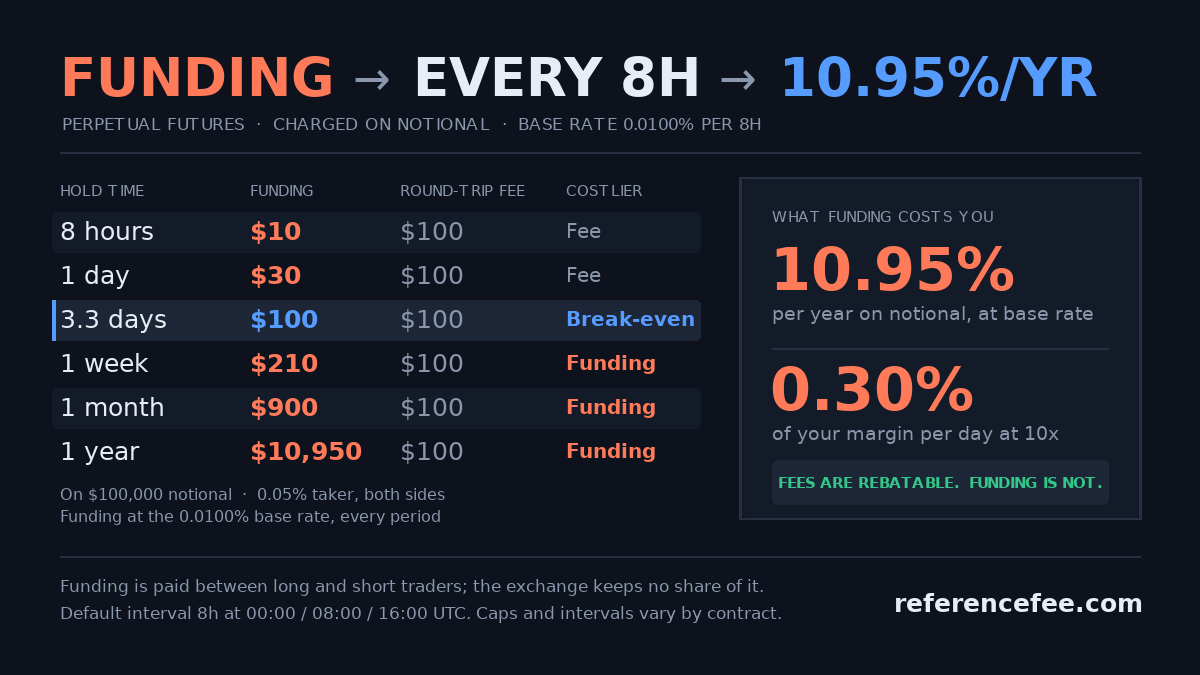
A leveraged position bills you in two ways, and most traders track only the first. The trading fee is charged once when you open and once when you close; the funding rate is charged again every eight hours for as long as the position stays open. Hold anything longer than a few days and the second line comfortably overtakes the first.
This guide answers what a funding rate is with the arithmetic attached: who pays whom, what the base rate compounds to over a year, the exact day it becomes more expensive than commission, and how the schedule differs across exchanges. There is also a distinction most explainers skip — part of your trading fee can be rebated, funding cannot. Miss that and your cost model is wrong.
What This Guide Covers
- What a funding rate is
- Who pays whom
- How the funding rate is calculated
- What the base rate costs over a year
- How leverage multiplies the funding rate
- Funding or fees: which costs more
- Intervals and caps across exchanges
- Is the funding rate rebatable
- Five ways to cut the cost
- Reading funding history first
- Frequently asked questions
What a Funding Rate Is
A funding rate is the periodic payment that tethers a perpetual contract to the spot price. A perpetual has no expiry, so it has no delivery date to force convergence. Exchanges close that gap with economic pressure instead: when the contract trades above spot, longs pay shorts; when it trades below, shorts pay longs.
The payment is calculated on the notional value of your position, not on your margin. Notional is mark price times contract quantity — the number leverage inflates. It is the same mechanism that makes leverage trading fees misleading, and it misleads for the same reason: the headline percentage looks small because the base it applies to is not your own capital.
One detail decides the cost. Funding does not accrue continuously; it is settled only against the snapshot at the payment timestamp. If your position is open at 00:00 UTC you pay that period in full, and if you closed at 23:59 you pay nothing for it. A position held seven and a half hours costs zero, one held eight hours and a minute costs a full period.
Who Pays Whom
This is what separates the funding rate from a trading fee: funding is not paid to the exchange. It is debited from one side of the book and credited to the other. The exchange runs the transfer and keeps nothing.
Three things follow from that single sentence. First, funding is not a one-way expense — hold a long while the rate is negative and you receive it. Second, the rate is an output of market positioning, which is why it stays positive for long stretches in a bull market: the crowd is on the long side. Third, and commercially the most important, a payment the exchange never collects has no share to give back. A crypto fee rebate covers commission; it does not cover funding.
How the Funding Rate Is Calculated
The payment itself is simple:
Funding payment = position notional × funding rate
The rate has two components. The first is a fixed interest component, set by default at 0.01% per eight-hour period on most major venues, or 0.03% a day. The second is a premium component measuring how far the contract has drifted from its index price, and it pushes the rate above or below that base.
To stop the number running away when the premium spikes, exchanges apply a dampener and a cap. Binance clamps the calculated rate by ±0.05% and limits the result to ±0.3% per eight-hour period on standard contracts. Whatever the app finally shows you is the output of that pipeline, and it is exactly what gets applied to your position.
A worked example
You open a long with 1,000 USDT of margin at 10x. Notional is 10,000 USDT. The rate sits at the 0.01% base and your position is open at settlement:
10,000 × 0.0001 = 1 USDT per period
One dollar looks like nothing. But there are three periods a day: 3 USDT daily, 90 USDT a month. Against 1,000 USDT of margin that is 9% a month, collected whether or not the price moves at all.
What the Base Rate Costs Over a Year
| Period | Accumulated rate | On a $100,000 notional position |
|---|---|---|
| 8 hours | 0.0100% | $10 |
| 1 day (3 periods) | 0.0300% | $30 |
| 1 week | 0.2100% | $210 |
| 1 month | 0.9000% | $900 |
| 1 year | 10.9500% | $10,950 |
The 10.95% a year figure is the whole point. Nobody describes a perpetual contract as borrowing at eleven percent annually, but that is precisely what sitting on the paying side of the base rate amounts to. In crypto bull markets the rate routinely runs three to four times base; at 0.03% per period the annual cost clears 30%.
How Leverage Multiplies the Funding Rate
| Leverage | Margin | Notional | Annual funding | As a share of margin |
|---|---|---|---|---|
| 1x | $10,000 | $10,000 | $1,095 | 10.95% |
| 5x | $10,000 | $50,000 | $5,475 | 54.75% |
| 10x | $10,000 | $100,000 | $10,950 | 109.50% |
| 20x | $10,000 | $200,000 | $21,900 | 219.00% |
Look at the 10x row: at base rate, a position left open for a year eats more than the entire margin behind it. Nobody holds one trade that long, but reducing it to a daily number changes nothing. At 10x the daily cost is 0.3% of your margin. If the market goes sideways you lose more than two percent a week, and nothing in your PnL chart explains why.
Funding or Fees: Which Costs More
| Holding period | Funding (0.01% / 8h) | Round-trip fee (0.05% taker) | Dominant cost |
|---|---|---|---|
| 1 hour | $0 | $100 | Fee |
| 8 hours | $10 | $100 | Fee |
| 1 day | $30 | $100 | Fee |
| 3.3 days | $100 | $100 | Break-even |
| 1 week | $210 | $100 | Funding |
| 1 month | $900 | $100 | Funding |
The crossover sits at roughly three and a half days. Below it your cost is governed by commission; above it funding takes over and never lets go while the position is open. Two trader profiles fall out of that, and each should be optimising a different line.
For an intraday scalper, funding is mostly noise; the real cost is the fee paid per trade. The largest saving there comes from working maker instead of taker and reclaiming part of what you pay — our maker vs taker fees guide prices that gap across eight exchanges. For a swing trader holding for weeks the table inverts: you pay the commission once and funding hundreds of times.
Intervals and Caps Across Exchanges
| Exchange | Default interval | Settlement times (UTC) | Note |
|---|---|---|---|
| Binance | 8 hours | 00:00 / 08:00 / 16:00 | Drops to 4h and 1h per contract in volatility |
| Bybit | 8 hours | 00:00 / 08:00 / 16:00 | More frequent on some pairs |
| OKX | 8 hours | 00:00 / 08:00 / 16:00 | Standard three periods |
| Bitget | 8 hours | 00:00 / 08:00 / 16:00 | Standard three periods |
For anyone holding a position, the interval can matter more than the headline rate. Binance runs some USDT-margined contracts on an hourly cycle and restores the four-hour frequency on the seventeenth period once the rate has stayed within 0.025% in absolute terms for sixteen consecutive periods. The same percentage is collected twenty-four times a day instead of three when the interval shortens.
Caps vary by venue and contract too. Binance limits standard contracts to ±0.3% per eight-hour period and reserves the right to revise that in extreme volatility. Funding at the cap means a daily cost of leverage times 0.9% of margin — 9% a day at 10x. That is a pace capable of ending an account without a liquidation ever printing.
Is the Funding Rate Rebatable
No, and the reason sits in the mechanism. A rebate redirects the referral commission an exchange pays out of the trading fee it collects. In funding, the exchange collects nothing; the money moves from one trader to another. With no revenue to share, there is no amount to return.
The practical consequence is that your cost model needs two separate lines:
- Trading fees — paid to the exchange, rebatable. ReferenceFee returns 50% of the fee on seven of eight exchanges and 40% on Binance, daily, in USDT, straight to your spot wallet.
- Funding — paid to the other side of the book, not rebatable. It is reduced only through position management, timing and instrument choice.
In numbers: an account generating $1,200,000 of monthly notional futures volume pays $600 in one-way commission at 0.05%; a 50% rebate returns $300 of that, or $3,600 a year. The same account’s funding cost is driven not by volume but by time in position, and that line is entirely under your control. Setting up the fee side takes two minutes — enter your UID in the ReferenceFee portal and it runs on its own.
Five Ways to Cut the Cost
1. Mind the settlement timestamp. Funding is charged only against positions open at the settlement moment. A trade that closes just before 00:00 UTC pays nothing for that period. On an intraday strategy this is the one adjustment available at zero cost.
2. Let the sign pick your side. When the rate is negative, a long receives funding. Where direction is already justified, the rate is a neutral tiebreaker between two otherwise equal setups.
3. Do not hold long-term exposure in a perpetual. For a position measured in months, the perpetual is an expensive instrument. Spot pays no funding, and dated futures have no funding mechanism at all — the cost is priced into the curve up front.
4. Compare the same pair across venues. Funding is derived from positioning in each exchange’s own book, so it differs between venues at the same moment. On a position held for weeks, a few basis points of difference outweighs the gap in commission.
5. Squeeze the line you can control. You cannot zero the funding rate, but you can cut the fee. Working maker reduces the futures commission by roughly 60%, and a rebate returns half of what is left. Together they take a 0.05% taker cost down to about 0.01% — our lowest fee crypto exchange comparison shows how the ranking shifts once rebates are applied.
Reading Funding History First
Every major exchange publishes the funding history for each contract. It is the only data that lets you price the cost of carrying a position before you open it, and most traders check it after sending the order. Three things are worth reading: the seven-day average, whether the sign has flipped, and how far the peak ran above base.
The average is the fastest way to estimate carry. If the last seven days averaged 0.02%, a position intended to run two weeks has an expected cost of about 0.84% of notional — $420 on a $50,000 position. A trader who leaves that out of the plan believes their target is closer than it is.
Sign flips describe how crowded positioning has become. A rate that stays sharply positive for days says longs are heavily crowded and a fast unwind is on the table; a rate sagging below zero says the reverse. That is not a trade signal on its own, but for anyone weighing the same setup from both directions it says plainly which side is cheaper to hold.
Persistently high positive funding is also the basis of what desks call cash and carry: buy spot, short the same size in the perpetual. Price risk is broadly neutral and the income comes from the funding payments. At 0.02% per eight hours the gross yield is around 21.9% a year. Gross matters — you pay commission on both legs, and the rate can fall or flip at any time. What usually decides the net on that structure is not the size of the funding but the fee on the two legs, and that is the only line a rebate shrinks directly.
Frequently Asked Questions
What is a funding rate?
A funding rate is the periodic payment exchanged between long and short holders of a perpetual contract to keep its price close to spot. On most major venues it settles every eight hours on the notional value of the position, and the default base is 0.01% per period.
Do I pay funding to the exchange?
No. Funding goes to traders on the other side of the book; the exchange only runs the transfer and keeps no share. Trading fees, by contrast, are paid to the exchange. That is why the two lines behave so differently.
Is funding charged on my margin?
No, on the notional value of the position. A position opened with $1,000 of margin at 10x has a notional of $10,000, and funding applies to that figure. This is why leverage multiplies the cost relative to your own capital.
Is the funding rate more expensive than trading fees?
It depends on how long you hold. At the base rate against a 0.05% taker fee the crossover is about three and a half days: below that the fee dominates, above it funding does. Over a month, funding reaches roughly nine times the round-trip commission.
Can I get a funding rate rebate?
No. A rebate is paid out of the referral commission an exchange funds from the trading fee it collects, and it collects no revenue on funding. Fees are rebatable, funding is not. Any service claiming to rebate 100% of funding is describing something affiliate programmes do not pay.
Can I avoid paying funding altogether?
Not in a perpetual, but you can get close to zero three ways: close before the settlement timestamp, sit on the side the rate is paying, or carry long-term exposure in spot or a dated futures contract instead.
What does a negative funding rate mean?
That the contract is trading below spot, meaning positioning is concentrated on the short side. Shorts pay and longs receive. Extended stretches of negative funding push the cost of holding a long below zero.
Summary
A trading fee is a visible cost; it sits line by line in your trade history. The funding rate is quiet: three times a day, on the notional value of the position, with no action from you. At the base rate that is 10.95% a year, or 0.3% of your margin per day at 10x, and it keeps working while the market goes nowhere.
The two lines need different remedies. Funding is managed with timing, direction and instrument choice — there is no share of it to reclaim. Commission does have a share to reclaim, and by default that share is going to somebody else. Price the line you cannot control correctly, and cut the line you can as far as it goes. Our crypto exchange fees guide is the place to start on the published numbers.
Trading digital assets carries substantial risk. Leveraged futures can result in the loss of your entire margin. The funding values and intervals quoted here are the exchanges’ published defaults; they vary by contract and can change without notice. Check the contract’s own exchange page for current values: Binance funding rate documentation.
What does this cost you?
Put your own monthly volume into the calculator and see the annual figure for your exchange and tier.
Run the numbers