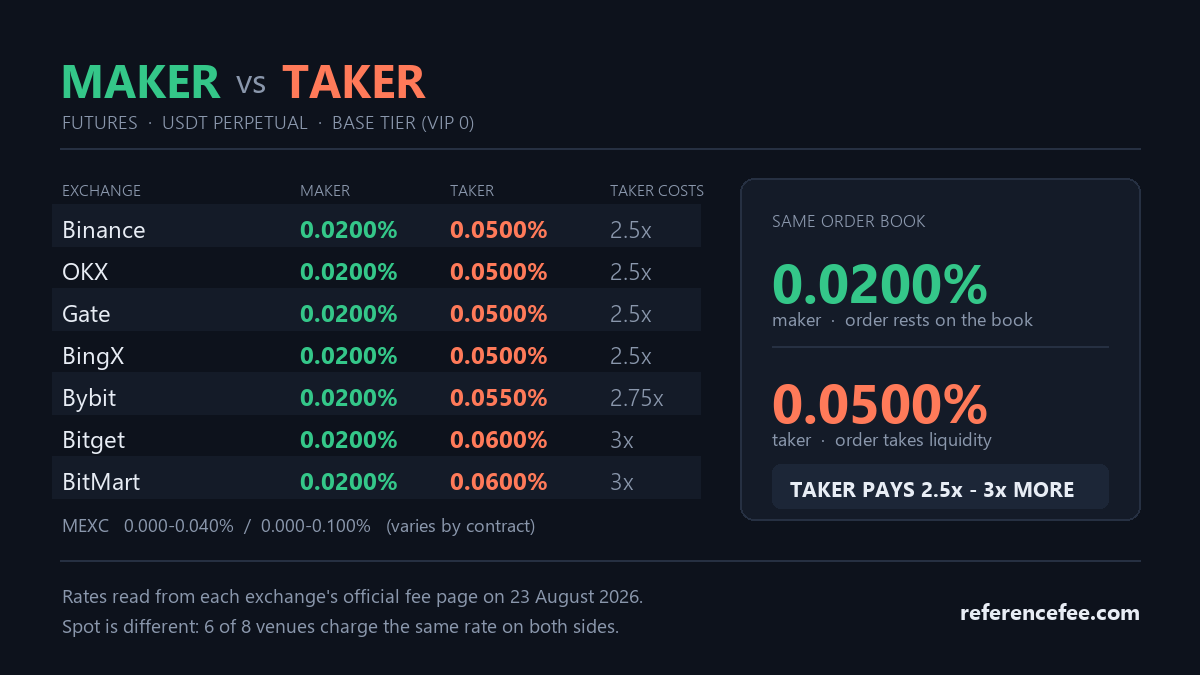
Every order you place is priced twice. Not by the market — by the exchange. The same trade, on the same pair, at the same second, costs one rate if your order sits on the book and a different rate if it takes liquidity off it. That is the maker vs taker split, and on futures it is the difference between paying 0.02% and paying 0.06% on identical size.
Most traders never choose. They hit the market button, which is always a taker order, and pay the higher number by default — often for years. This guide prices the maker vs taker choice exactly, using rates read directly off each platform’s official fee page on 23 August 2026, at the base tier every new account starts on.
What This Guide Covers
- What maker vs taker actually means
- Spot rates: where the maker vs taker gap disappears
- Futures rates: where the gap is worth real money
- When the maker fee goes negative
- How to actually get maker fills
- The math on real trading volume
- The cost layer underneath maker vs taker
- Frequently asked questions
What Maker vs Taker Actually Means
A maker order is one that does not fill immediately. It rests in the order book at your chosen price and adds liquidity, so the exchange charges you the maker fee. A taker order fills right away against an order that is already sitting there, removing liquidity, so you pay the taker fee. Market orders are always taker. Limit orders are maker only if they do not cross the spread. That is the whole maker vs taker rule.
That last sentence is where most of the confusion in the maker vs taker question lives. A limit order is not automatically a maker order. If you place a buy limit at or above the current best ask, it matches instantly and you are charged as a taker, exactly as if you had used a market order. The order type does not decide your fee — where your price sits relative to the book does.
The logic behind maker vs taker pricing is simple enough. An exchange is only useful if there are resting orders to trade against, so it discounts the traders who supply them and charges the traders who consume them. What varies enormously between platforms is how much of a discount the maker side actually gets.
Spot Rates: Where the Maker vs Taker Gap Disappears
| Exchange | Spot maker | Spot taker | Maker discount |
|---|---|---|---|
| MEXC | 0.0000% | 0.0000% – 0.0500% | Zero maker across the board |
| OKX | 0.0800% | 0.1000% | 20% |
| Binance | 0.1000% | 0.1000% | None |
| Bybit | 0.1000% | 0.1000% | None |
| Bitget | 0.1000% | 0.1000% | None |
| Gate | 0.1000% | 0.1000% | None |
| BingX | 0.1000% | 0.1000% | None |
| BitMart | 0.1000% | 0.1000% | None |
Here is the finding nobody puts in a headline: on spot, at the tier you are almost certainly on, the maker vs taker distinction is mostly fictional. Six of the eight venues charge the identical rate on both sides. Placing patient limit orders on Binance, Bybit, Bitget, Gate, BingX or BitMart spot earns you a better fill price, but not one satoshi of fee discount.
Only OKX prices the two sides differently at base tier — 0.08% maker against 0.10% taker, a 20% discount for supplying liquidity. MEXC sits outside the comparison entirely with a zero maker rate, though its taker band is promotional and pair-specific rather than a permanent platform-wide rate. If you want the full spot picture across venues, our lowest fee crypto exchange comparison ranks all eight on headline cost.
Futures Rates: Where the Maker vs Taker Gap Is Worth Real Money
| Exchange | Futures maker | Futures taker | Taker costs this much more |
|---|---|---|---|
| Binance | 0.0200% | 0.0500% | 2.5× |
| OKX | 0.0200% | 0.0500% | 2.5× |
| Gate | 0.0200% | 0.0500% | 2.5× |
| BingX | 0.0200% | 0.0500% | 2.5× |
| Bybit | 0.0200% | 0.0550% | 2.75× |
| Bitget | 0.0200% | 0.0600% | 3× |
| BitMart | 0.0200% | 0.0600% | 3× |
| MEXC | 0.000% – 0.040% | 0.000% – 0.100% | Varies by contract |
On futures the maker vs taker relationship inverts completely. Not one venue in this set treats the two sides equally: the maker rate is 0.02% everywhere, and takers pay between two and a half and three times that. The spread between exchanges is one basis point. The spread between maker and taker on the same exchange is three to four basis points.
Read that again, because it reorders the usual advice. Moving your account from the most expensive taker rate in the table to the cheapest saves 17%. Moving from taker to maker on the venue you already use saves 60% or more. The maker vs taker decision is a bigger lever than the choice of exchange, and it costs nothing but patience.
One quiet detail from Binance’s schedule is worth knowing: USDC-margined futures pairs are charged 0.0000% maker at every tier including Regular User, against 0.0400% taker. On those specific contracts the maker vs taker gap is not 2.5× — it is infinite.
When the Maker Fee Goes Negative
Climb the VIP ladder and the maker vs taker gap stops being a discount and becomes a payment. OKX takes its maker rate to 0.0000% at VIP 6 and to −0.0050% at VIP 8 and VIP 9, on both spot and futures — a genuine rebate credited on every filled maker order. Bybit’s Supreme VIP tier reaches 0.0000% maker on perpetuals, and Binance’s futures schedule hits 0.0000% maker at VIP 9.
These tiers demand hundreds of millions in monthly volume, so they are not a plan for a retail account. They matter because of what they reveal: exchanges are willing to pay for resting liquidity and to charge heavily for consuming it. The maker vs taker structure is not an accounting quirk, it is the price of the service, and it scales exactly the way the venue’s incentives do.
How to Actually Get Maker Fills
Knowing the maker vs taker split is worthless without the execution habit that captures it. Four things do most of the work:
- Use post-only orders. Every major venue offers a post-only flag that cancels the order instead of letting it cross the spread. It is the only setting that guarantees maker treatment — a plain limit order does not.
- Quote inside your own time frame. Resting an order one tick behind the book is free if your edge plays out over hours. It is expensive if you are scalping a one-minute chart.
- Split large orders. A size that would sweep three levels of the book pays taker on all three. Working it in slices lets most of the fill rest.
- Never chase with market orders on exits. Stop-market and liquidation fills are taker fills at the worst possible moment. A planned exit limit is both cheaper and calmer.
The honest trade-off: maker orders do not always fill, and the ones that do fill often fill because the market moved against you. Saving three basis points is not worth missing a move that pays fifty. Treat the maker vs taker choice as a default to return to, not a rule to obey when the setup demands immediacy. Our guide to the hidden cost of leverage trading fees covers what compounds on top of this.
The Math on Real Trading Volume
| Monthly futures notional | All taker (0.05%) | All maker (0.02%) | Saved per year |
|---|---|---|---|
| $100,000 | $50 | $20 | $360 |
| $500,000 | $250 | $100 | $1,800 |
| $1,200,000 | $600 | $240 | $4,320 |
| $5,000,000 | $2,500 | $1,000 | $18,000 |
The maker vs taker gap compounds fast. A $5,000 account running 10× leverage and turning its balance over three times a week clears roughly $1,200,000 of notional in a month without feeling like a heavy trader. That is the third row: $4,320 a year decided purely by which side of the maker vs taker split the orders land on. No strategy change, no extra risk, no venue migration.
The Cost Layer Underneath Maker vs Taker
There is a second discount sitting under both sides of maker vs taker, and it works whether you are a maker or a taker. Every fee you pay contains a referral commission that the exchange pays out to whoever introduced your account. If nobody claimed it, the exchange keeps it. Either way the money leaves your balance.
A rebate service redirects that share back to you. On ReferenceFee it is up to 50% of the commission on eight supported exchanges — Binance at 40%, the rest at 50% — paid daily in USDT straight into your exchange spot wallet, with no minimum and no payout request. The published fee rate does not change; the portion that would have gone to an affiliate comes back to you the next morning.
Stack the two and the arithmetic gets interesting. That $1,200,000-a-month trader paying taker rates spends $600 monthly. Switching to maker discipline takes it to $240. Adding a 50% rebate takes it to $120 — an 80% cut from the starting point, from two changes that alter nothing about the strategy itself. Venue-specific numbers are in our Bybit fee guide, Bitget fee guide and MEXC fee guide.
Frequently Asked Questions
What is the difference between maker vs taker fees?
A maker fee is charged when your order rests in the order book and adds liquidity. A taker fee is charged when your order fills immediately against an existing order and removes liquidity. Makers are charged less because exchanges need resting orders; takers pay a premium for instant execution.
Are limit orders always maker orders?
No. A limit order that crosses the spread fills immediately and is charged as a taker. Only an order that rests on the book without matching earns the maker rate. Use the post-only flag if you need certainty.
Does the maker vs taker split matter on spot trading?
At base tier, rarely. Six of the eight exchanges checked charge the same rate on both sides of spot. Only OKX gives a base-tier maker discount, at 0.08% against 0.10%. The gap opens up at VIP tiers and on futures.
Which exchange has the biggest maker vs taker gap on futures?
Bitget and BitMart, at 0.0200% maker against 0.0600% taker — three times the cost for taking liquidity. Binance, OKX, Gate and BingX sit at 0.0200% against 0.0500%, and Bybit at 0.0200% against 0.0550%.
Can the maker side of maker vs taker actually pay me?
At high VIP tiers, yes. OKX publishes a −0.0050% maker rate at VIP 8 and VIP 9, meaning the exchange credits you on filled maker orders. Reaching it requires volume no retail account produces.
Does a fee rebate apply to both maker and taker fees?
Yes. The rebate is calculated on the referral commission inside whatever you actually pay, so it applies to maker fills and taker fills alike, and stacks on top of any maker discount or native-token discount.
The Bottom Line
The maker vs taker split is the most reliably ignored line item in crypto trading, and on futures it is worth more than every exchange-comparison table ever written. One basis point separates the cheapest venue from the most expensive; three to four basis points separate the two sides of the same order book on any one of them.
Fix the maker vs taker habit first — post-only by default, market orders only when the setup genuinely demands them. Then reclaim the referral commission buried inside whatever you still pay. Since July 2024 that second layer has returned more than $260,000 to over 2,100 traders across eight exchanges, on maker fills and taker fills alike.

Trading digital assets carries substantial risk. A lower fee base does not lower market risk or guarantee profitability. All rates quoted were read from official exchange fee pages on 23 August 2026 and may change without notice. Full schedules: OKX fee rates.
What does this cost you?
Put your own monthly volume into the calculator and see the annual figure for your exchange and tier.
Run the numbers