Your entry can be wrong, your thesis can be wrong, your timing can be wrong. The fee is the one line on the statement that is knowable in advance and, unlike everything else, partly under your control. Most traders still pay the sticker price — the rate a brand-new, unverified account sees on its first order — for years.
There are five separate levers that lower crypto trading fees, and they are independent: pulling one does not disqualify you from the others. This guide prices all five on seven exchanges, using rates read from each platform’s own fee schedule on 12 September 2026, and says plainly which ones are worth the trouble at retail size and which are marketing.
What This Guide Covers
- The five levers, ranked by what they cost you
- Lever 1: stop paying the taker rate
- Lever 2: pay the fee in the exchange’s own token
- Lever 3: VIP tiers and the asset-balance shortcut
- Lever 4: trade the cheaper product
- Lever 5: take back part of the fee you already paid
- Stacking all five: a worked example
- Four things that do not lower your fee
- Frequently asked questions
The Five Levers, Ranked by What They Cost You
| Lever | Typical cut | What it costs you | Works from day one? |
|---|---|---|---|
| Maker instead of taker | 60–64% on futures | Patience — your order may not fill | Yes |
| Native token fee payment | 10–25% | Holding a volatile token | Yes |
| VIP tier | 0–20% at the first rung | $30K–$100K parked, or millions in volume | No |
| Cheaper product or pair | Up to 100% | Limited to specific markets | Yes |
| Fee rebate | 40–50% | Linking a UID once | Yes |
Read the third column before the second. The two levers that cut crypto trading fees hardest on paper — VIP status and maker discipline — are also the two that ask something real of you. The other three cost almost nothing and are skipped anyway, mostly because nobody ever sat down and priced them.
Lever 1: Stop Paying the Taker Rate
Every venue charges two rates. A market order removes liquidity and pays the taker fee; a limit order that rests on the book adds liquidity and pays the maker fee. On futures the gap is not a rounding error:
| Exchange | Futures maker | Futures taker | Cut if you fill as maker |
|---|---|---|---|
| Binance (USDⓈ-M) | 0.0200% | 0.0500% | 60% |
| Bybit | 0.0200% | 0.0550% | 64% |
| OKX | 0.0200% | 0.0500% | 60% |
| Bitget | 0.0200% | 0.0600% | 67% |
| Gate | 0.0200% | 0.0500% | 60% |
| BingX | 0.0200% | 0.0500% | 60% |
| MEXC | 0.000%–0.040% | 0.000%–0.100% | Varies by contract |
This is the single largest reduction available to crypto trading fees, and it is free. Six of the seven charge exactly 0.0200% to makers. The entire spread between “cheap exchange” and “expensive exchange” on futures lives in the taker column — which means the venue matters far less than the order type. Our maker vs taker fee guide works through the mechanics; the practical version is post-only orders, a limit price one tick inside the book, and the discipline to let a fill go.
On spot the same lever exists but pays less. Binance, Bybit, Bitget, Gate and BingX all charge 0.1000% to both sides at base tier, so a maker fill saves nothing there; only OKX splits spot at 0.0800% maker against 0.1000% taker, and only BingX’s higher tiers open a real spot gap.
Lever 2: Pay Crypto Trading Fees in the Exchange’s Own Token
Four of the seven let you settle crypto trading fees in their native token and take a percentage off for it. The discount is applied on top of your existing tier, so it is genuinely additive — but every one of them requires the toggle to be switched on and a sufficient balance sitting in the right wallet.
| Exchange | Token | Discount | Base spot rate after discount |
|---|---|---|---|
| Binance | BNB | 25% spot, 10% futures | 0.07500% (futures 0.0180% / 0.0450%) |
| Bybit | MNT | 25% spot, 10% futures | 0.0750% (futures 0.0180% / 0.0495%) |
| Bitget | BGB | 20% spot | 0.08% / 0.08% |
| Gate | GT | 10% spot | 0.09% / 0.09% |
| MEXC | MX | Shown per account eligibility | Spot maker already 0.0000% |
Two catches worth knowing before you buy the token. Bybit’s rule is all-or-nothing: if your MNT balance will not cover the whole fee at the moment the order is confirmed, the discount does not apply and you pay the full rate in the settlement currency — partial payment is not supported. And the toggle is per product and per account, so enabling it for spot does not enable it for futures, and enabling it on the main account does not enable it on a subaccount.
The honest arithmetic: a 10% discount on a 0.0500% futures taker fee is 0.0050%. On $1,000,000 of monthly volume that is $50 a month, against the price risk of holding a token you would not otherwise own. On spot at 25% the case is much stronger — 0.1000% becomes 0.0750%, a $250 saving per $1M traded.
Lever 3: VIP Tiers and the Asset-Balance Shortcut
This is the lever everyone assumes is the answer, and the first rung is usually the least rewarding of the five. Here is what it actually takes to reach VIP 1, and what VIP 1 actually gives you:
| Exchange | Cheapest route to VIP 1 | Futures taker at VIP 1 | Change vs base |
|---|---|---|---|
| Gate | $2,000 in assets, or 50 GT held 14 days | 0.05% | No change until VIP 3 |
| Bitget | $30,000 daily balance, or $5M futures volume | 0.06% | Maker only: 0.02% → 0.019% |
| Bybit | $100,000 asset balance, or $10M derivatives volume | 0.0400% | 27% cheaper |
| OKX | $100,000 in assets, or $5M futures volume | 0.0450% | 10% cheaper |
| Binance | $5M volume and 5 BNB held | 0.0500% | Maker only: 0.0200% → 0.0180% |
Three things fall out of that table. First, the qualifying route almost nobody uses is the asset balance: Bybit and OKX both grant VIP 1 for $100,000 held on the platform, with no trading requirement at all, and both refresh the level daily. Second, Binance is the strict one — it requires the volume and the token balance, not either, and its first two spot tiers leave the taker fee untouched at 0.100%. Third, Gate’s tier is almost free to reach and does nothing for futures until VIP 3.
The wider point for anyone trading retail size: VIP tiers are a rebate for people who already have money on the platform or who churn millions monthly. If neither describes you, the tier ladder is not where your crypto trading fees are going to fall. The lowest fee crypto exchange comparison ranks all of them at the tier a normal account actually sits on.
Lever 4: Trade the Cheaper Product
Some fee reductions are not discounts at all — they are a different market with a different published rate. Three are worth knowing:
- Binance USDC-margined perpetuals. The maker rate is 0.0000% and the taker rate 0.0400%, against 0.0200% / 0.0500% on the USDT-margined equivalent. A maker fill on a USDC contract is free.
- MEXC spot. The published maker rate is 0.0000%, with the taker rate ranging from 0.0000% to 0.0500% by pair.
- OKX spot. At 0.0800% maker it is the only venue of the seven that does not charge base-tier spot makers the full 0.1000%.
The trade-off is liquidity. A cheaper contract with a wider spread is not cheaper: one extra tick of slippage on a $10,000 position typically costs more than the entire fee saving. Price the spread, not the fee schedule, before moving a strategy onto a thinner book.
Lever 5: Take Back Part of the Fee You Already Paid
The four levers above all cut crypto trading fees before you trade. The fifth works after: every exchange pays out a share of your fee as affiliate commission, and that share is paid whether or not anyone claims it. If your account is not linked to a partner, the exchange keeps it. A rebate service sits in the partner slot and returns most of that share to you.
| Exchange | Futures taker (base) | Rebate share | Net fee after rebate |
|---|---|---|---|
| OKX | 0.0500% | 50% | 0.0250% |
| Gate | 0.0500% | 50% | 0.0250% |
| BingX | 0.0500% | 50% | 0.0250% |
| Bybit | 0.0550% | 50% | 0.0275% |
| Binance | 0.0500% | 40% | 0.0300% |
| Bitget | 0.0600% | 50% | 0.0300% |
Compare that net column against the VIP table above. A 50% rebate at base tier puts you at 0.0250% on OKX — below OKX’s own VIP 3 taker rate of 0.0280%, which requires $2,000,000 in assets or $50,000,000 of monthly volume. That is the argument in one line: the rebate delivers a tier most accounts will never trade their way into, on day one, at any size. Our guide to how a crypto fee rebate works covers the mechanism in detail.
What it cannot do is worth stating too. It does not change your fill price, your margin or your liquidation level, because the fee is charged in full at execution and the share comes back afterwards. And it is never retroactive — commission already paid out cannot be reassigned, so every day an account sits unlinked is gone.
Stacking All Five: A Worked Example
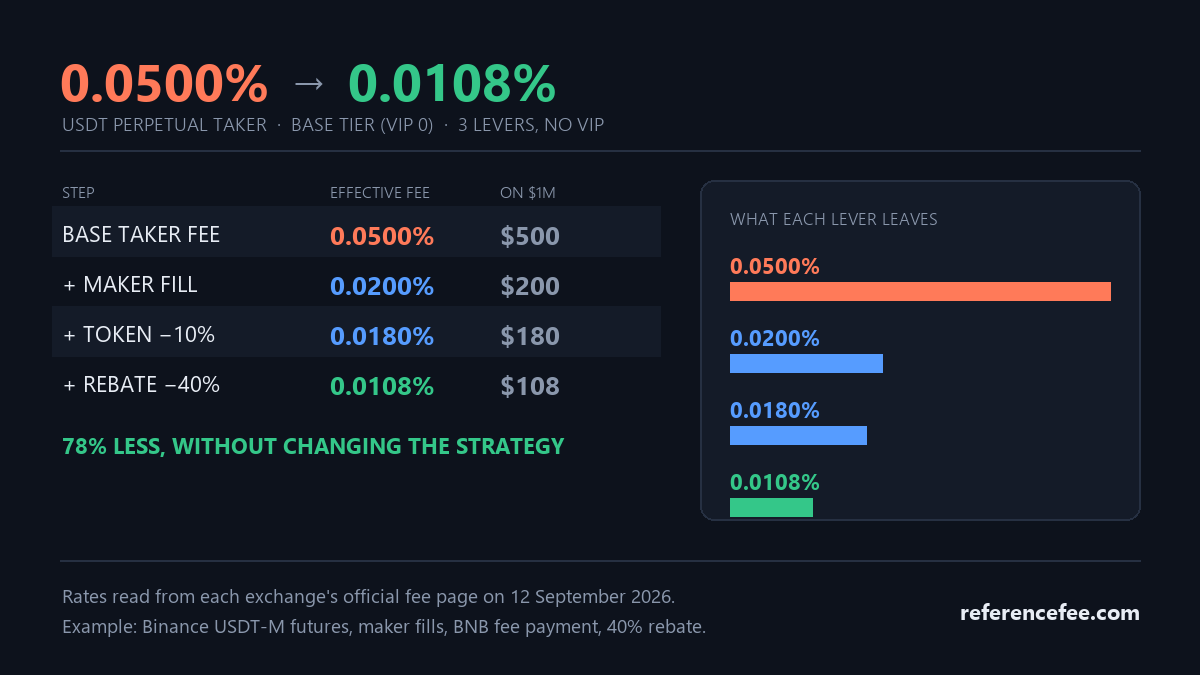
Take a trader running $1,000,000 of monthly notional on Binance USDⓈ-M futures, starting from the default: market orders, no BNB, no tier, no rebate.
| Step | Rate | Cost on $1M | Saved so far |
|---|---|---|---|
| Base taker fee | 0.0500% | $500 | — |
| + Maker fills instead of taker | 0.0200% | $200 | 60% |
| + BNB fee payment (10% off) | 0.0180% | $180 | 64% |
| + 40% rebate on what remains | 0.0108% | $108 | 78% |
Three changes, none of which touch the strategy, take $500 a month to $108 — $4,700 a year on a volume level a $5,000 account at 10× leverage reaches without feeling like a heavy trader. The same stack on Bybit, where MNT pays 10% off futures and the rebate share is 50%, lands at 0.0090%.
Notice what is absent from that table: VIP status. It contributes nothing here because $1,000,000 a month does not reach VIP 1 on Binance futures, which starts at $5,000,000 and 5 BNB. The three levers that did the work are available to every account regardless of size.
Four Things That Do Not Lower Your Fee
- Lower leverage. Futures fees are charged on notional value, not on margin. A $1,000 position at 20× pays the same fee as a $20,000 spot-equivalent position — leverage multiplies the fee base, it does not change the rate.
- Holding the token without enabling deduction. BNB, MNT, BGB and GT discounts require the fee-deduction setting to be switched on for that product. A wallet full of the token with the toggle off pays full price.
- Splitting volume across subaccounts. This does not reduce crypto trading fees and can only hurt: OKX, Binance and Bybit all aggregate main and subaccount volume for tier purposes, and subaccounts inherit the main account’s tier.
- Chasing zero-fee promotions. A zero-fee pair with a wide spread costs more than a 0.1% pair with a tight one. Bybit also states that spot volume executed at zero fees does not count toward your spot trading volume — so it buys no progress toward a tier either.
Frequently Asked Questions
What is the fastest way to reduce crypto trading fees?
Switch from market orders to post-only limit orders. On futures that single change cuts the fee 60% at every major venue — 0.0500% to 0.0200% on Binance, OKX, Gate and BingX, and 0.0550% to 0.0200% on Bybit. It costs nothing, needs no balance and applies from your next order.
Do VIP tiers actually save money for a retail trader?
Rarely at the first rung. Binance VIP 1 leaves the spot and futures taker rates unchanged, Gate’s futures fee does not move until VIP 3, and Bitget’s VIP 1 only improves the maker side. Bybit and OKX are the exceptions, granting VIP 1 for a $100,000 asset balance with no trading requirement.
Can I use a fee rebate and a VIP discount at the same time?
Yes. The affiliate commission a rebate returns is calculated on the fee you actually paid, so it applies after every other reduction. VIP tiers, native-token discounts and maker rates all survive it. The only thing that does not stack is a second referral relationship, since one account carries one affiliate attribution.
Is paying fees with BNB or MNT worth it?
On spot, usually — 25% off a 0.1000% fee saves $250 per $1,000,000 traded. On futures the discount is 10%, worth $50 per $1,000,000, which may not justify holding a volatile token. Both exchanges require the deduction toggle on and a balance large enough to cover the whole fee.
Do crypto trading fees differ between spot and futures?
Substantially. Base-tier spot is 0.1000% on most venues, while USDT-perpetual futures are 0.0200% maker and 0.0500%–0.0600% taker. Futures fees look smaller but apply to leveraged notional, so the same margin generates far more fee volume on futures than on spot.
How often do exchanges change their fee schedules?
Base-tier rates are stable for months at a time, but tier thresholds and token-discount terms move more often — MEXC replaced its public VIP volume table with an M-Score system, and Bybit’s fee page was last updated on 2 September 2026. Always check the venue’s own fee page before relying on a number.
Before You Trade Again
Rank the five levers on crypto trading fees by what they cost you, not by the headline percentage. Maker discipline and a linked UID are free and available today; a token discount costs you price exposure; a VIP tier costs you six figures of parked capital or millions in volume. Most traders pull the expensive lever and skip the free ones.
Every rate in this guide came from the exchange’s own published schedule on 12 September 2026 — for example OKX’s fee page, which lists both the tier table and the qualifying criteria. Fee schedules change without much warning, and regional rates differ; verify at the source before you size a position around a number. For the full base-tier picture across venues, see our crypto exchange fee comparison.
What does this cost you?
Put your own monthly volume into the calculator and see the annual figure for your exchange and tier.
Run the numbers