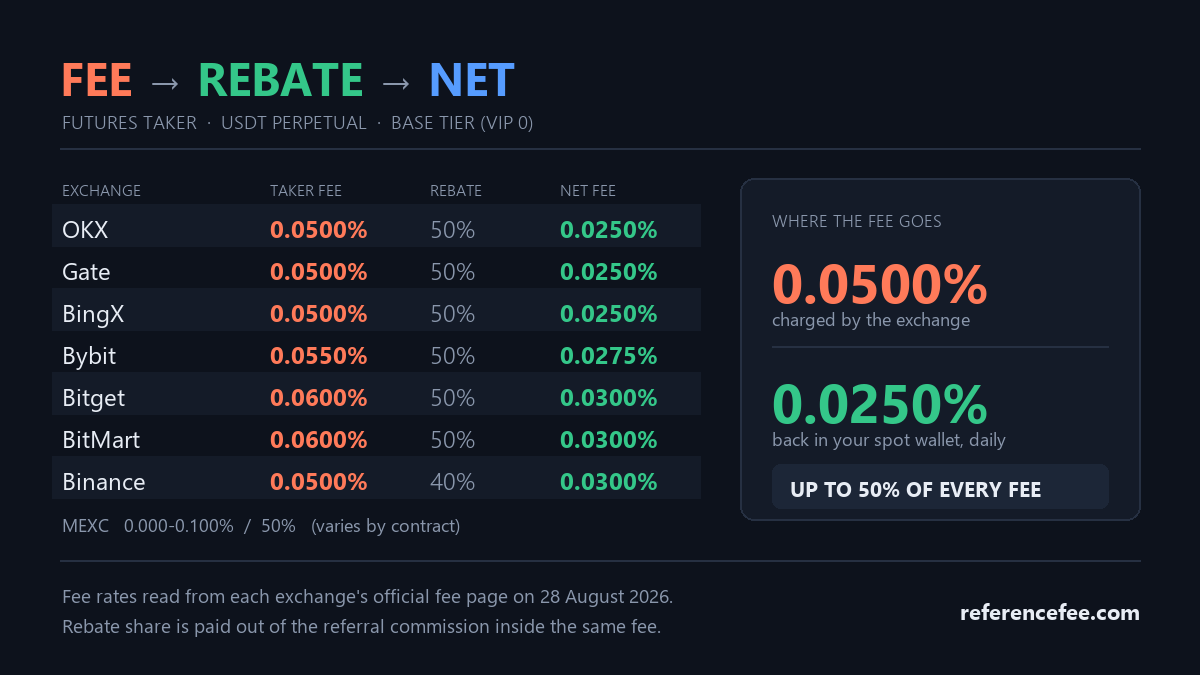
You cannot negotiate the fee your exchange charges. You can, however, claim a slice of it back — and most traders never do, because the slice in question is paid to somebody else entirely. That is the whole idea behind a crypto fee rebate: the exchange already hands out a share of your fee as referral commission, and a rebate service points that share back at you instead of keeping it.
This guide explains where the money actually comes from, what a crypto fee rebate is worth on each of the eight exchanges covered here, and what it does to your effective fee. Every rate quoted was read from each platform’s own fee schedule on 28 August 2026, at the base tier every new account starts on.
What This Guide Covers
- What a crypto fee rebate actually is
- Where the money comes from
- What it is worth on eight exchanges
- Your effective fee after a crypto fee rebate
- How a rebate stacks with VIP tiers and token discounts
- Why crypto fee rebate payout mechanics matter more than the headline share
- What a legitimate service never asks for
- Frequently asked questions
What a Crypto Fee Rebate Actually Is
A crypto fee rebate is a share of the trading fee you have already paid, returned to you after the trade settles. It is not a discount, not a coupon and not a promotional rate. The exchange charges its published fee in full, the trade closes at that price, and a portion comes back afterwards — on ReferenceFee, daily, in USDT, into your exchange spot wallet.
The distinction matters because it changes what the rebate can and cannot do. It cannot make your fill cheaper at the moment of execution, so your liquidation price, your margin requirement and your position sizing are all unaffected. What it does change is the only fee number that describes your actual cost of doing business over a year: the net rate you keep paying after the money comes back.
That is also why a crypto fee rebate is one of the few edges in trading that carries no market risk. It does not depend on a thesis being right. It pays exactly the same on your worst month as on your best one, because it is calculated on volume traded, not on profit made.
Where the Money Comes From
Every major exchange runs an affiliate programme. When an account registers through a partner link, the exchange pays that partner a commission calculated on the fees the account generates — for the lifetime of the account, not just the first month. This is a standard, published part of how exchanges buy growth, and it is funded out of the fee you pay.
So the fee splits three ways whether you know it or not. The exchange keeps most of it. A commission share goes to whoever introduced the account. If nobody introduced it, the exchange simply keeps that part too. Either way the money has left your balance, which is the point most traders miss: there is no version of this where you pay less by staying unaffiliated.
A crypto fee rebate service sits in the partner position and returns most of that commission to the trader instead of banking it. The chain behind a crypto fee rebate is short — you pay the standard fee, the exchange pays the commission, the service keeps a small operating share, and the rest lands back in your wallet. Nothing about your trading changes: same platform, same order book, same published rate, same execution.
Two consequences follow from the mechanics. First, the link matters more than the account: the commission is attributed at registration, which is why services ask you to open the venue through their link or to submit your UID for an existing account. Second, a crypto fee rebate can never be retroactive — commission that was already paid out or absorbed cannot be reassigned. Every day an account sits unlinked is a day the recoverable share is gone for good.
What a Crypto Fee Rebate Is Worth on Eight Exchanges
| Exchange | Futures taker (base tier) | Rebate share | Net taker fee |
|---|---|---|---|
| OKX | 0.0500% | 50% | 0.0250% |
| Gate | 0.0500% | 50% | 0.0250% |
| BingX | 0.0500% | 50% | 0.0250% |
| Bybit | 0.0550% | 50% | 0.0275% |
| Bitget | 0.0600% | 50% | 0.0300% |
| BitMart | 0.0600% | 50% | 0.0300% |
| Binance | 0.0500% | 40% | 0.0300% |
| MEXC | 0.000% – 0.100% | 50% | Half of whatever the contract charges |
Read the net column rather than the headline one, because it reorders the ranking every comparison table publishes. On headline taker fees, Binance, OKX, Gate and BingX are tied at the top and Bitget looks 20% more expensive. After a crypto fee rebate, Binance’s 40% share drops it to 0.0300% — level with Bitget and BitMart, and more expensive than the three venues paying 50%.
Nothing about Binance got worse. The rebate share is simply a second variable, and a venue with a slightly higher published fee and a bigger rebate can end up cheaper than a venue with a lower published fee and a smaller one. If you want the pre-rebate ranking on its own, our lowest fee crypto exchange comparison covers all eight on headline cost.
On spot the arithmetic is the same but the base is larger. Seven of the eight charge 0.1000% at base tier, so a 50% crypto fee rebate takes the effective spot rate to 0.0500% — below what any of them publish at VIP 1, reached without a dollar of extra volume.
Your Effective Fee After a Crypto Fee Rebate
| Monthly futures volume | Fees paid at 0.0500% | Returned at 50% | Per year |
|---|---|---|---|
| $100,000 | $50 | $25 | $300 |
| $500,000 | $250 | $125 | $1,500 |
| $1,200,000 | $600 | $300 | $3,600 |
| $5,000,000 | $2,500 | $1,250 | $15,000 |
| $20,000,000 | $10,000 | $5,000 | $60,000 |
The third row is the one worth sitting with. A $5,000 account running 10× leverage and turning over its balance three times a week clears roughly $1,200,000 of monthly notional without feeling like a heavy trader — and a crypto fee rebate on that volume is $3,600 a year, or $10 a day, arriving whether the month was green or red.
Two levers compound here, and they are independent. Trading maker instead of taker cuts the base fee by around 60% on futures; our maker vs taker fee guide prices that split across the same eight venues. Applying a crypto fee rebate on top halves whatever remains. Together they take a 0.0500% taker cost down to 0.0100% — an 80% reduction from two changes that alter nothing about the strategy itself.
How a Crypto Fee Rebate Stacks With VIP Tiers and Token Discounts
A common assumption is that a rebate replaces the discounts you already have. It does not. The commission is calculated on the fee you actually paid, so a crypto fee rebate applies after every other reduction and stacks with all of them:
- VIP tiers. Climb from Regular User to VIP 3 and your fee falls; the rebate then takes its share of the smaller number. You keep both.
- Native token discounts. BNB pays 10% off futures fees and 25% off spot, Bitget’s BGB takes 20% off spot, Gate’s GT takes spot from 0.1% to 0.09%. All of them survive a rebate.
- Maker rates. Maker fills carry commission exactly like taker fills, so a crypto fee rebate applies to both; post-only discipline and a rebate are additive rather than alternatives.
- Promotional zero-fee pairs. Where the fee is genuinely zero there is no commission and therefore no rebate — half of nothing is nothing. Binance’s USDC-margined futures maker rate and MEXC’s zero-maker spot pairs fall into this group.
The one thing that does not stack is a second referral relationship. An account carries a single affiliate attribution, so you cannot layer two rebate services on one UID.
Why Crypto Fee Rebate Payout Mechanics Beat the Headline Percentage
| Typical rebate service | ReferenceFee | |
|---|---|---|
| How it is paid | You request it | Automatic |
| How often | Weekly or monthly | Every day |
| Minimum to withdraw | Around 20 USDT | None |
| Where it lands | A platform balance you then withdraw | Your exchange spot wallet |
| Waiting time | Up to 48 hours after you ask | None |
An advertised 55% that lands in a platform wallet, above a 20 USDT threshold, after a payout request that clears in two days, is worth less than a 50% crypto fee rebate that arrives in your spot wallet every morning. The first is a number in someone else’s database. The second is margin, or a position, or dry powder, on the day it lands.
Three questions separate the two cases, and all three are answerable before you sign up. Where does the money land — a platform balance or your exchange wallet? What is the minimum before you can touch it? And how often does it settle: daily, weekly, or whenever the operator gets to it? A high headline share attached to bad answers is a worse crypto fee rebate than a modest share attached to good ones.
What a Legitimate Crypto Fee Rebate Service Never Asks For
The mechanics of a crypto fee rebate require exactly one piece of information about you: your UID, the plain account number the exchange shows on your profile page. A UID identifies an account for commission attribution. It cannot place orders, cannot move funds and cannot be used to log in.
So the red flags are easy to enumerate. No rebate service needs API keys — trading permissions have nothing to do with commission attribution. None needs a deposit, because there is nothing on the rebate side to fund. None needs identity documents; the exchange already did that KYC and the rebate provider is not a financial institution in this chain. And none needs your exchange password, ever.
Two softer warnings are worth watching too. A service promising 100% of the fee back is describing something the affiliate programme does not pay, and a service that holds your balance while raising minimums is optimising float rather than paying traders. If the numbers behind an offer do not reconcile with the exchange’s own published commission structure, they are marketing rather than arithmetic. Our breakdown of crypto exchange fees shows what those published figures look like.
Can You Get a Crypto Fee Rebate on an Existing Account?
Sometimes. Affiliate attribution is normally fixed at registration, which is why the default route is to open the venue through a partner link. A few exchanges do allow an existing account to be linked to a partner afterwards, and the ones that do are shown in the app before you start rather than discovered later.
Where linking an existing account is not possible, the practical answer is a second account at a venue you already use, or applying the crypto fee rebate to the next exchange you were going to open anyway. Neither is a reason to move your trading somewhere unfamiliar — the venue-specific numbers are in our Bybit fee guide, Bitget fee guide and MEXC fee guide.
Frequently Asked Questions
What is a crypto fee rebate?
A crypto fee rebate is a share of the trading fee you have already paid, returned to you after the trade settles. It comes out of the referral commission the exchange pays to whoever introduced your account, not out of the exchange’s published fee schedule, which stays exactly the same.
How much does a crypto fee rebate return?
On the eight exchanges covered here, a crypto fee rebate returns 50% of the fee on seven of them and 40% on Binance. At base-tier futures rates that turns a 0.0500% taker fee into 0.0250%, and a 0.1000% spot fee into 0.0500%.
Does a crypto fee rebate change my trading fee at the exchange?
No. You are charged the standard published rate at execution, so your fill price, margin and liquidation level are identical. The rebate arrives afterwards as a separate credit, which is why it lowers your effective annual cost rather than the price of any single trade.
Is it safe to give a crypto fee rebate service my UID?
A UID is a public account identifier, not a credential. It cannot place orders, withdraw funds or log in. A service asking for API keys, a deposit, identity documents or your exchange password is asking for something the rebate mechanism does not require.
Can I claim a rebate on fees I paid in the past?
No. Commission is attributed at the moment of the trade, so a crypto fee rebate only applies from the day your UID is linked. Fees paid before that are closed — which is the entire cost of putting the setup off.
Does a crypto fee rebate stack with my VIP level and token discount?
Yes. It is calculated on whatever you actually paid, so it applies after VIP tier reductions, BNB, BGB or GT discounts and maker pricing. The only exception is a genuinely zero-fee pair, where there is no commission to share.
The Bottom Line
The referral commission inside your trading fee is paid on every trade you make, on every one of these eight venues, whether or not anyone claims it. That is the uncomfortable part: the default is not “no rebate”, it is “the rebate goes to someone else”. A crypto fee rebate is simply the decision to redirect it.
Setting up a crypto fee rebate takes a UID and about two minutes, and the arithmetic afterwards is unglamorous and reliable: half the fee back, every morning, for as long as you keep trading. Since July 2024 that mechanism has returned more than $260,000 to over 2,100 traders across eight exchanges — on winning trades and losing ones alike.

Trading digital assets carries substantial risk. A lower effective fee does not lower market risk or guarantee profitability. All rates quoted were read from official exchange fee pages on 28 August 2026 and may change without notice. Full schedules: OKX fee rates.
What does this cost you?
Put your own monthly volume into the calculator and see the annual figure for your exchange and tier.
Run the numbers