If you trade with leverage on any crypto exchange, leverage trading fees are almost certainly your single largest expense – bigger than your losing trades. In the high-stakes world of cryptocurrency trading, “Leverage” is often marketed as the ultimate equalizer—a tool that allows a retail trader with $1,000 to command the power of $100,000. While the potential for exponential gains is the primary draw, there is a “silent killer” lurking in every order book: The Notional Value Fee Trap.
At Referencefee, we believe that every dollar saved on fees is a dollar added to your net profit. In this deep dive, we will break down the brutal mathematics of leverage trading fees, show you the exact formula exchanges use, and explain how a professional rebate system can transform your long-term ROI.
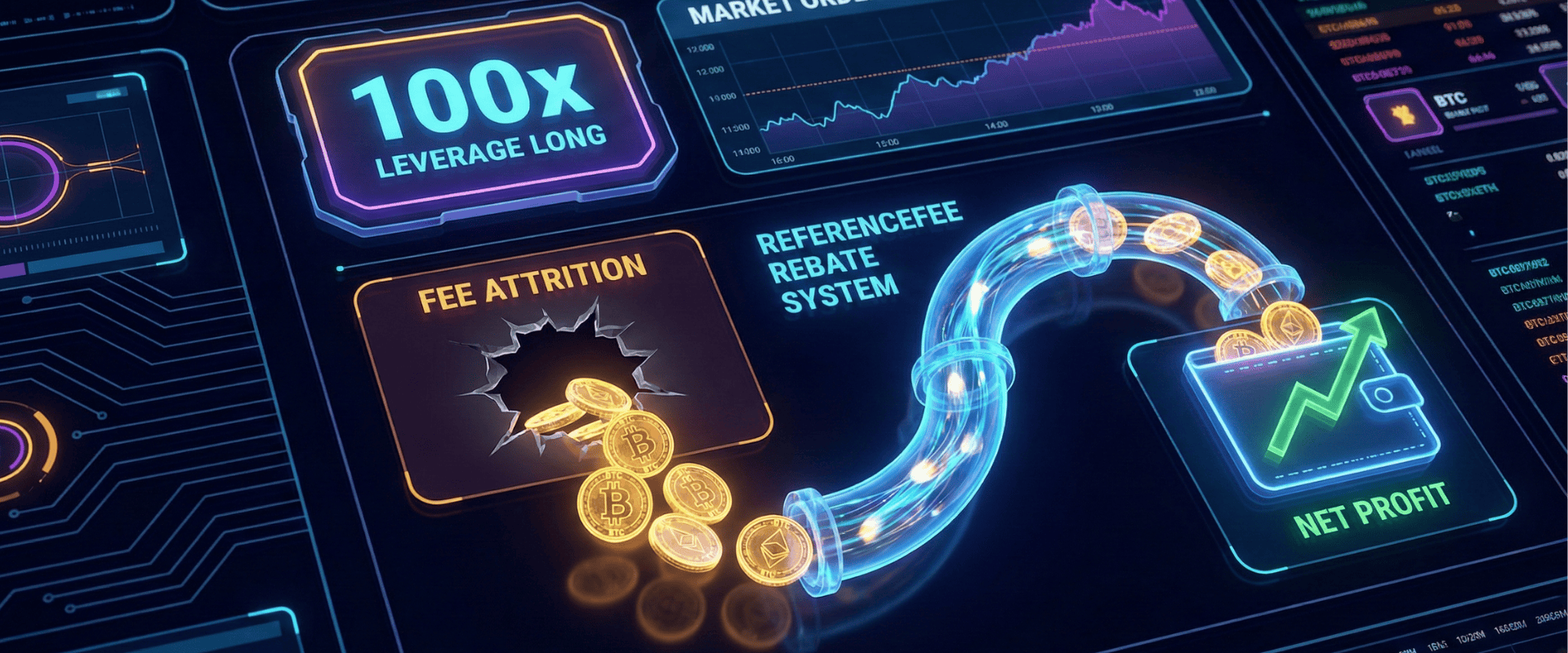
1. Leverage Trading Fees and the Math of Notional Value
Most beginner traders make a fundamental mistake: they assume fees are calculated based on their Initial Margin. Unfortunately, exchanges calculate leverage trading fees based on the Notional Value (Total Position Size).
When you open a position with 1,000 USDT at 100x leverage, you are not trading 1,000 USDT. You are managing a contract worth 100,000 USDT. Even a tiny “Taker” fee of 0.06% applies to that 100,000 figure.
The Breakdown
Let’s look at the numbers for a standard high-leverage trade:
- Initial Margin (M): 1,000 USDT
- Leverage (L): 100x
- Fee Rate (f): 0.06% (Standard Taker Fee)
The formula for the total cost of a round-trip trade (opening and closing) is:
Total Fee = M × L × f × 2
Plugging in the numbers:
1,000 × 100 × 0.0006 × 2 = 120 USDT
Read that again. You deposited 1,000 USDT and paid 120 USDT in leverage trading fees – 12% of your entire margin – before the market moved a single tick in either direction. Put differently, price has to travel 0.12% in your favour just to get you back to break-even.
2. The Compounding Effect of Fee Attrition
Professional trading is a game of margins. A trader with a 55% win rate is considered highly successful. However, when you factor in the high cost of leverage trading fees, that 55% win rate can easily turn into a net loss. This is known as Fee Attrition.
Over a year, an active trader might generate millions of dollars in volume. A retail trader doing 5,000,000 in monthly volume pays roughly 3,000 to 6,000 USDT in fees. Over 12 months, that is up to 72,000 USDT. For most traders, this amount is often larger than their total account balance.
Fee attrition is silent because it never appears as a losing trade on your PnL chart. It is deducted contract by contract, which is exactly why so many traders never diagnose it. If you have never audited this number, start with our primer on what a trading fee actually is, then come back to the leverage math above.
3. How Leverage Trading Fees Differ Between Exchanges
Not every venue charges the same. A few basis points of difference in the taker rate compounds into thousands of dollars a year once leverage multiplies your notional volume. We maintain a separate breakdown for each major exchange:
- Bybit: see how to recover Bybit’s hidden 0.055% cost.
- Bitget: see how to recover the hidden 0.06% taker cost.
- MEXC: see our MEXC fee guide and cashback walkthrough.
The pattern is identical everywhere: the headline rate looks trivial, but leverage trading fees are charged on notional value, so the effective cost against your own capital is the headline rate multiplied by your leverage. At 100x, a 0.06% fee is a 6% charge on your margin per side.
4. Enter Referencefee: Reclaiming the “House Edge”
In a casino, the “house” always wins because of a small statistical edge. In crypto, the exchange is the house, and the fees are their edge. Referencefee was built by software architects and financial engineers to give that edge back to the trader.
A Rebate (or Cashback) system is not a simple discount. It is a strategic partnership where the exchange shares a portion of the commission they collect with us, and we pass the majority of that back to you. We explain the wider mechanics in why trading fees destroy your profits.
How Much Can You Save?
Using the 100x leverage example from earlier where you paid 120 USDT in leverage trading fees:
- Standard Fee: 120 USDT
- Referencefee Rebate (e.g., 40%): 48 USDT
- Net Fee Paid: 72 USDT
By using Referencefee, you have effectively lowered your “Break-even” point and kept 4.8% of your total capital in your pocket. In the world of professional trading, a 4.8% saving per trade is the difference between a blown account and a sustainable career.
5. Why Referencefee is the Professional’s Choice
There are many “referral codes” on the internet, but Referencefee is a Financial Technology Platform. We provide institutional-grade infrastructure for retail traders.
Transparency Through Engineering
We don’t ask you to trust us; we provide the data. Our custom-built dashboard connects to exchange APIs to track every single satoshi you pay in fees.
- Automated Tracking: No more manual spreadsheets. Our microservices architecture syncs your trade data in real-time.
- Historical Analysis: See exactly how much you have saved over weeks, months, and years.
- No Hidden Clauses: Our rates are among the highest in the industry because we value long-term partnerships over short-term gains.
6. Bridging the Gap Between Retail and Institutional
Institutional market makers and hedge funds never pay full price for fees. They have direct “Rebate” agreements with exchanges. Historically, retail traders were left out of this loop.
Referencefee bridges this gap. By aggregating thousands of traders under one umbrella, we command the same respect and fee structures as large institutions. When you join Referencefee, you are essentially joining a “Trading Union” that fights for your right to keep your profits.
7. How to Start Cutting Your Leverage Trading Fees
Connecting your account to Referencefee takes less than 2 minutes and requires zero sensitive information. We never ask for your private keys or withdrawal permissions.
- Select Your Exchange: Choose from our partners like Bybit, MEXC, Bitget or OKX.
- Create a New Account: Use the Referencefee link to ensure the exchange recognizes you as a “Rebate-eligible” trader.
- Link to Dashboard: Enter your UID into the Referencefee portal.
- Trade and Collect: Continue your trading strategy as usual. Watch your rebates accumulate in your dashboard and withdraw them whenever you like.
Frequently Asked Questions About Leverage Trading Fees
Are leverage trading fees charged on my margin or my position size?
On your position size. Exchanges apply the fee rate to notional value, not to the margin you posted. This is the single most misunderstood point about leverage trading fees, and it is why a 0.06% taker rate becomes a 6% charge against your own capital at 100x.
Do I pay the fee twice?
Yes. You are charged when you open the position and again when you close it. That is why every calculation on this page multiplies by two for a round trip.
Does a rebate change how I trade?
No. Your strategy, leverage, order types and risk management stay exactly the same. The rebate is applied to commissions the exchange has already collected, so it only affects what lands back in your account.
Can I get rebates on an account I already have?
Usually not. Exchanges attribute rebate eligibility at registration, which is why step 2 above asks you to open a fresh account through the referral link before connecting your UID.
Conclusion: Stop Leaving Money on the Table
Trading is hard enough. Fighting the market, the news cycle, and your own emotions is a full-time job. You shouldn’t have to fight the exchange’s fee structure too.
Whether you are a scalper doing 100 trades a day or a swing trader using high leverage, every cent you pay in leverage trading fees is a hurdle to your success. Referencefee.com is here to remove those hurdles.
Don’t let leverage trading fees be the silent killer of your portfolio. Join Referencefee today and start trading like an institution.
What does this cost you?
Put your own monthly volume into the calculator and see the annual figure for your exchange and tier.
Run the numbers