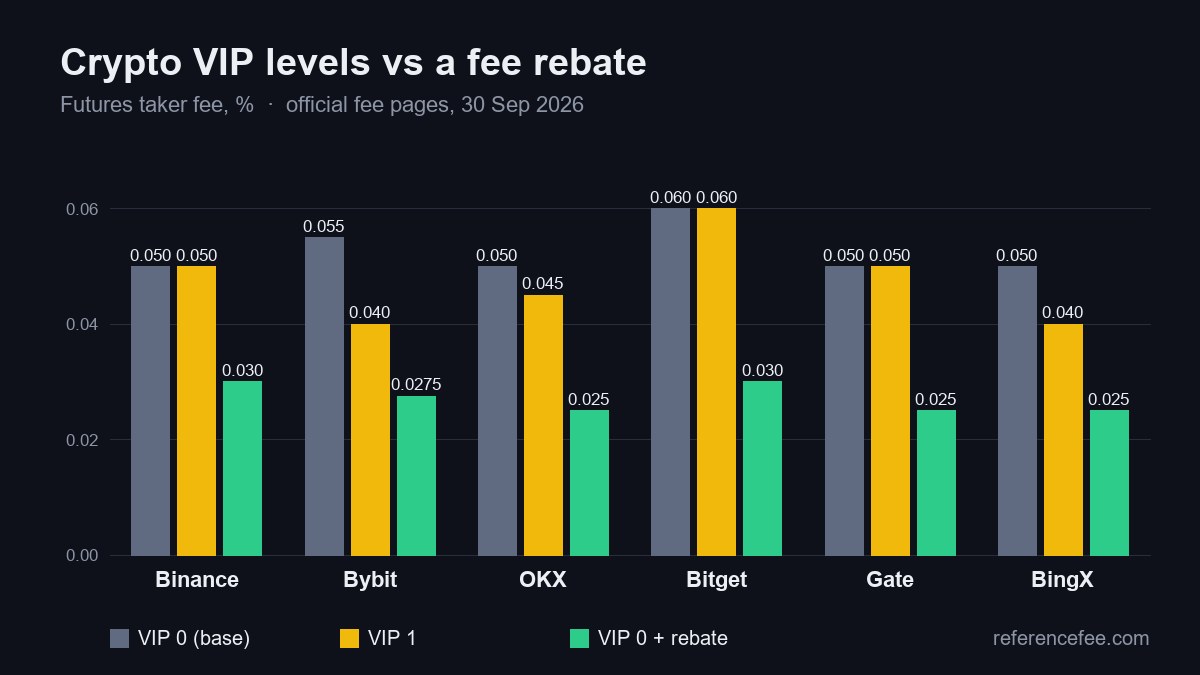
Every exchange sells its crypto VIP levels the same way: trade more, pay less, get a badge. The fee schedule is a staircase, and the implied promise is that each step saves you money. What the schedule does not show is how tall the first step is, or how little is waiting at the top of it.
So we read the staircases. This guide compares the crypto VIP levels of seven exchanges — the volume or balance each one asks for VIP 1, and the fee it actually gives you in return — using each venue’s own published fee page on 30 September 2026. Then it puts the answer next to the one fee cut that needs no volume at all. On three of the six venues that publish a VIP 1 futures rate, reaching VIP 1 does not lower your taker fee by a single basis point.
What This Guide Covers
- What crypto VIP levels are, and how you qualify
- How we read the tables
- Futures: what VIP 1 costs and what it pays
- Spot: the same staircase, shorter steps
- The volume trap: paying fees to earn a discount
- VIP 1 or a fee rebate: the numbers side by side
- Do crypto VIP levels and a rebate stack?
- Two shortcuts: balances and status matching
- When chasing a VIP tier is worth it
- Frequently asked questions
What Crypto VIP Levels Are, and How You Qualify
Crypto VIP levels are fee tiers. Every account starts at the base tier — called VIP 0, Regular User or Non-VIP depending on the venue — and moves up when it clears a threshold measured over a rolling 30-day window. Because the window rolls, a quiet month drops you back down.
There are three kinds of threshold, and venues mix them differently:
- Trading volume. Your 30-day notional volume, usually counted separately for spot and futures. Leverage counts in full: a $1,000 position at 10× is $10,000 of volume.
- Asset balance. The dollar value held on the account. On several venues a large enough balance qualifies you with no trading at all.
- Native token holdings. BNB on Binance, BGB on Bitget, GT on Gate. On Binance this is not an alternative but an extra condition.
The word that decides everything is the small one between the columns. Where the table says or, any single criterion is enough. Where it says and, you need all of them — and that one word is the difference between a tier you can reach and one you cannot.
How We Read the Tables
Every figure below was read on 30 September 2026 from the exchange’s own public fee or VIP page, logged out, at the published rate — the same rate a new account sees. We recorded the VIP 0 and VIP 1 maker and taker fees for spot and USDT-margined perpetual futures, and the VIP 1 qualifying criteria. Token-payment discounts (paying fees in BNB, BGB or GT) are left out so the tiers compare like for like.
Two venues from our usual set of eight need a note. BitMart’s fee page did not load on the day: two attempts both ended in a connection timeout, so BitMart is left out rather than filled with an older number. MEXC no longer runs a volume-based VIP table on its public pages; its VIP address now redirects to an “M-Score” and Alpha Trader programme, and its fee page lists rates per trading pair instead of per tier. MEXC appears in the tables with that caveat.
Futures: What VIP 1 Costs and What It Pays
Futures is where crypto VIP levels matter most, because it is where active traders put their volume. Here is the first step of each staircase.
| Exchange | VIP 0 maker / taker | VIP 1 requires (30 days) | VIP 1 maker / taker | Taker cut |
|---|---|---|---|---|
| Bybit | 0.0200% / 0.0550% | $10M derivatives volume, or $1M spot, or $100K assets | 0.0180% / 0.0400% | −27% |
| BingX | 0.0200% / 0.0500% | Not published | 0.0140% / 0.0400% | −20% |
| OKX | 0.0200% / 0.0500% | $5M futures volume, or $100K assets | 0.0160% / 0.0450% | −10% |
| Binance | 0.0200% / 0.0500% | $5M futures volume and 5 BNB | 0.0180% / 0.0500% | 0% |
| Bitget | 0.0200% / 0.0600% | $5M futures volume, or 30,000 USDT assets, or 11,981 BGB | 0.0190% / 0.0600% | 0% |
| Gate | 0.0200% / 0.0500% | $60K volume, or $2K assets, or 50 GT | 0.0200% / 0.0500% | 0% |
| MEXC | Rates set per contract (maker 0.000–0.040%, taker 0.000–0.100%); no public volume tiers | |||
Read the last column first. Binance, Bitget and Gate all leave the futures taker fee exactly where it was at VIP 1. Binance and Bitget trim the maker fee slightly; Gate changes nothing at all until VIP 3, where the taker fee moves from 0.050% to 0.048%. Gate has by far the easiest crypto VIP levels to reach — $60,000 of monthly volume — and the reason is visible in the table: the first two steps are decorative.
The only meaningful VIP 1 futures discounts are Bybit’s, which takes the taker fee from 0.0550% to 0.0400%, and BingX’s, from 0.0500% to 0.0400%. Bybit’s price for that is $10 million of derivatives volume in 30 days. BingX does not publish its threshold at all; its VIP page offers an application form instead.
Spot: the Same Staircase, Shorter Steps
On spot, the crypto VIP levels are cheaper to reach, and the cuts are a little more generous.
| Exchange | VIP 0 maker / taker | VIP 1 requires (30 days) | VIP 1 maker / taker |
|---|---|---|---|
| BingX | 0.100% / 0.100% | Not published | 0.035% / 0.060% |
| Bybit | 0.100% / 0.100% | $1M spot volume, or $100K assets | 0.0675% / 0.0800% |
| OKX | 0.080% / 0.100% | $1M volume, or $100K assets | 0.0675% / 0.0800% |
| Bitget | 0.100% / 0.100% | $500K spot volume, or 30,000 USDT assets | 0.080% / 0.080% |
| Gate | 0.100% / 0.100% | $60K volume, or $2K assets | 0.099% / 0.099% |
| Binance | 0.100% / 0.100% | $1M spot volume and 5 BNB | 0.090% / 0.100% |
| MEXC | Maker 0.000%, taker 0.000–0.050% by pair; no public volume tiers | ||
Binance repeats the pattern from futures: VIP 1 lowers the spot maker fee to 0.090% and leaves the taker fee at 0.100%. Gate’s spot VIP 1 is worth one thousandth of a percentage point. Bitget, Bybit and OKX give a real 20% taker cut, for $500,000 to $1 million of monthly spot volume.
The Volume Trap: Paying Fees to Earn a Discount
Crypto VIP levels are priced in volume, and volume is paid for in fees. That is the part the staircase leaves out. To qualify for Bybit’s futures VIP 1 through trading, you need $10 million of monthly derivatives volume. At the base taker rate of 0.0550%, that volume costs $5,500 in fees every month before the discount begins.
What does the discount return? At VIP 1 the same $10 million costs $4,000 in taker fees instead of $5,500 — a saving of $1,500 a month. It is real money, but you only get it by keeping up a volume that already costs thousands, and you lose it the month your volume dips.
On OKX the arithmetic is thinner. $5 million of futures volume at 0.0500% is $2,500 in monthly taker fees; VIP 1 cuts that to $2,250. The reward for clearing the threshold is $250 a month. On Binance, Bitget and Gate, it is nothing on the taker side.
This is the trap: crypto VIP levels reward volume you would have traded anyway, and they punish anyone who trades extra to reach them. Overtrading to hit a tier is the most expensive way there is to lower a fee.
VIP 1 or a Fee Rebate: the Numbers Side by Side
A crypto fee rebate works the other way round. It returns a share of every fee you pay, from the first trade, with no threshold and no monthly reset. ReferenceFee’s published shares are 50% on Bybit, OKX, Bitget, Gate, BingX and MEXC, and 40% on Binance. Here is what that does to the futures taker fee, set against VIP 1:
| Exchange | VIP 0 taker | VIP 1 taker | VIP 0 + rebate (net) | Volume needed for the rebate |
|---|---|---|---|---|
| OKX | 0.0500% | 0.0450% | 0.0250% | None |
| Gate | 0.0500% | 0.0500% | 0.0250% | None |
| BingX | 0.0500% | 0.0400% | 0.0250% | None |
| Bybit | 0.0550% | 0.0400% | 0.0275% | None |
| Binance | 0.0500% | 0.0500% | 0.0300% | None |
| Bitget | 0.0600% | 0.0600% | 0.0300% | None |
On every venue in the table, the rebate at VIP 0 beats VIP 1 by a wide margin. The closest case is Bybit, where VIP 1 cuts the taker fee by 0.015 points and a 50% rebate cuts it by 0.0275 points — nearly twice as much, without the $10 million.
Now take a realistic account. A trader doing $1 million of futures volume a month, all taker, on OKX:
- Chasing VIP 1: $1 million is a fifth of the $5 million threshold. No discount. Fees: $500 a month.
- Taking a rebate: $500 paid, $250 returned. Net fees: $250 a month, or $3,000 a year kept.
At that volume, no crypto VIP level on any of the six venues gives a futures taker discount through trading alone. Gate would grant VIP 1, and VIP 1 on Gate changes nothing. The rebate is the only fee cut on the table that account can actually reach.
Do Crypto VIP Levels and a Rebate Stack?
Yes. A rebate is calculated on the fee you actually paid, so it applies after the VIP discount rather than instead of it. A Bybit trader at VIP 1 pays 0.0400% on futures taker fills; a 50% rebate brings that to 0.0200% net. That is less than half of the 0.0550% the same trader started on.
The two levers do different jobs. Crypto VIP levels lower the price per trade once your volume is large enough. A rebate lowers every trade, at every volume, including the months when you do not qualify. A trader who is close to a tier loses nothing by taking the rebate first, and keeps it when the tier arrives. Our guide to reducing crypto trading fees covers the other levers that stack on top, and trading maker instead of taker is the biggest of them.
Two Shortcuts: Balances and Status Matching
Volume is not the only way up. Two routes skip it entirely, and both are worth knowing before you trade a single dollar extra for a tier.
Hold instead of trade. On Bybit and OKX, $100,000 in assets qualifies for VIP 1 on its own. On Bitget, 30,000 USDT does. For an account that already holds that much, the discount is free — and if it is not already there, moving idle funds onto an exchange for a fee tier adds counterparty risk that a fee saving rarely justifies.
Ask for a match. Several venues will copy a tier you hold elsewhere. Gate’s VIP page offers a trial two levels above your status on another exchange; BingX offers a 30-day trial up to two levels higher, capped at VIP 5; Bitget lists existing VIPs on other exchanges as eligible. All three require proof — a screenshot of your VIP page and UID on the other venue.
When Chasing a VIP Tier Is Worth It
Crypto VIP levels are not useless. They are just built for a different trader than most people reading a fee table. Three rules cover it:
- If your natural volume is already within reach of a threshold that pays, take the tier. Bybit futures at $10 million, or Bybit, OKX or Bitget spot at $500,000 to $1 million, are real discounts.
- If the tier cuts only the maker fee, or cuts nothing, as on Binance, Bitget and Gate futures at VIP 1, ignore it. Do not trade a dollar extra for it.
- Whatever your volume, take the rebate first. It works at VIP 0, keeps working at every tier, and never resets.
For the headline fee on each venue before any of this, see our lowest fee crypto exchange ranking, and for the venue with the most useful first tier, the Bybit fee rates guide.
Frequently Asked Questions
How often are crypto VIP levels recalculated?
Continuously, on a rolling 30-day window. OKX, for example, states that the level you hold on one day sets your fee for the next trading day. A strong month lifts you up; a quiet one drops you back down within days, so a tier reached by a one-off burst of trading rarely lasts.
Which exchange has the easiest VIP 1?
Gate, at $60,000 of 30-day volume or $2,000 in assets. But Gate’s VIP 1 leaves the futures fee unchanged at 0.02% maker and 0.05% taker, and cuts spot by 0.001 points. The easiest tier is also the emptiest one. Among meaningful discounts, Bitget’s spot VIP 1 at $500,000 is the lowest volume bar.
Why does Binance’s VIP 1 not lower the taker fee?
Binance’s VIP 1 lowers only the maker fee: spot maker moves from 0.100% to 0.090%, futures maker from 0.0200% to 0.0180%. Taker fees stay at 0.100% and 0.0500% until VIP 2 on futures and VIP 3 on spot. Binance also requires 5 BNB in addition to the volume, not instead of it.
Does a fee rebate stop working when I reach a VIP tier?
No. A rebate is a share of the fee you actually pay, so it follows you up the tiers and applies to the lower VIP rate. On Bybit futures at VIP 1, a 50% rebate turns a 0.0400% taker fee into 0.0200% net. The two discounts add up rather than replace each other.
Can I get a VIP tier without trading?
Often, yes. Bybit and OKX grant VIP 1 for $100,000 in assets, Bitget for 30,000 USDT. Gate, BingX and Bitget also match VIP status you hold on another exchange, usually for a limited trial and with proof of your tier and UID there.
Do crypto VIP levels apply to maker orders too?
Yes, and on some venues they apply only to maker orders at the first step. Binance and Bitget futures VIP 1 lower the maker fee and leave the taker fee untouched. If you trade mostly with market orders, check the taker column before you count on a tier.
Before You Chase the Next Tier
Crypto VIP levels are marketed as a reward for loyalty. Read as tables, they are a price list: this much volume, this much discount. On 30 September 2026, VIP 1 bought no taker discount at all on three of six futures venues, and the best one on offer asked for $10 million a month. A rebate cut more than any of them, from the first trade.
Every rate above comes from each exchange’s public fee or VIP page on 30 September 2026 — including OKX’s fee schedule — and fee tables change without notice, so check the page before you plan around a tier. If a rebate is the lever you were missing, it takes one sign-up to start.
What does this cost you?
Put your own monthly volume into the calculator and see the annual figure for your exchange and tier.
Run the numbers